|
|
|
|
As we enter the second week of recovery, I want to take a moment to reaffirm our commitment
to supporting each of you—our members, partners, campuses, and communities. The past week has been challenging, but it has also shown the incredible resilience and solidarity within our APNC family. Please know that we are here for you, and we will continue to stand by your side throughout this recovery journey.
To better support everyone involved, we’re transitioning our email updates to Mondays and Fridays. This will allow us to consolidate information and resources while ensuring you still have access to timely updates. For any developments in between, we will immediately post new information to our Hurricane Helene Resource Hub on the APNC website. This hub will remain your go-to source for the latest resources, messages, and support tools, available whenever you need them.
I’m also pleased to share that we are receiving more relief supplies at our office, which include essentials to aid those hardest hit. Our team is working diligently to sort and prepare these items for distribution, and we’re doing everything possible to get these supplies to Western North Carolina as quickly as we can. We know that many are still in urgent need of support, and we’re committed to making sure help reaches those who need it most.
In today’s message, we also have a special note from APNC’s Board President, Suzanne Miszur-Porter, who also serves as the Executive Director of United Way of Rutherford County. Suzanne will be sharing insights on the ongoing relief efforts and how United Way is contributing to the recovery in Rutherford County and surrounding areas. We are incredibly grateful for her leadership at APNC and in Rutherford County.
Thank you for your continued strength and the care you’ve shown for each other. If there’s anything more we can do to assist, don’t hesitate to reach out. We’re here for you now and in the weeks to come.
Sara M. Howe, APNC CEO
|
|
|
NEW! Read an update from our Board Chair, Suzanne Miszur-Porter, Executive Director of The United Way of Rutherford County here.
|
|
|
|
|
NEW! Insight Recovery Center Hosting Marathon NA Meetings
Every night for the foreseeable future Insight Recovery is hosting marathon NA meetings from 7pm to 10 pm. Bring a chair, and there will be a porta potty for attendees.
|
|
|
NEW! ARC is Open and Seeing Patients
Asheville Recovery Center (ARC), located at 9 Old Burnsville Hill Road, #7, is fully operational and ready to see patients. Click above for more details on the services they offer.
|
|
|
Hurricane Helene Relief for Insight Recovery Center
Insight Recovery Center offers compassionate, comprehensive, holistic and evidence based addiction treatment. They have started a gofundme campaign to support their ongoing needs post-Helene. Donate here.
|
|
|
|
|
NEW! Governor Cooper Issues Executive Order to Increase Capacity of Healthcare to Respond to Helene
RALEIGH: A vast array of relief resources continues to flow into Western North Carolina to assist in Hurricane Helene recovery.
More than 1,500 North Carolina National Guard personnel at work in Western NC are being supported by soldiers from the 18th Airborne Corps headquartered at Fort Liberty. Those soldiers are partnered with NCDOT to assist in clearing roads and with county emergency managers in distributing commodities. Soldiers are also assisting with search and rescue, and air traffic control - managing the large number of aircraft flying relief missions over western counties.
The U.S. Army Corps of Engineers is assisting with assessing water and wastewater plants and dams. More than $27 million FEMA Individual Assistance funds have been paid so far to Western NC disaster survivors and more than 83,000 people have registered for Individual Assistance. Nearly 1,400 people are now housed in hotels through FEMA’s Transitional Sheltering Assistance.
More than 755 FEMA personnel are on the ground assisting in the western North Carolina relief effort. In addition to search and rescue and providing commodities, they are meeting with disaster survivors in shelters and neighborhoods to provide rapid access to relief resources. They can be identified by their FEMA logo apparel and federal government identification. More than 1,100 responders from 34 states are supporting response and recovery efforts through the Emergency Management Assistance Compact (EMAC). This includes public health nurses, emergency management teams supporting local governments, veterinarians, teams with search dogs and more.
“Resources from around the nation are at work helping Western North Carolina’s storm response and recovery,” said Governor Roy Cooper. “We are grateful for assistance that’s supporting the thousands of our North Carolina responders.”
Governor Cooper issued an executive order that increases the capacity of the healthcare workforce to respond to Helene by making it easier for healthcare professionals licensed in other states, recent retirees, and others with necessary skills to assist with North Carolina’s response and recovery. In addition, the order authorizes the State Health Director to issue standing orders for emergency medications and authorizes the Department of Health and Human Services to modify or waive fees for replacement of vital records.
Beware of Misinformation
North Carolina Emergency Management and local officials are cautioning the public about false Helene reports and misinformation being shared on social media. NCEM has launched a fact versus rumor response webpage to provide factual information in the wake of this storm. FEMA is also maintaining a rumor response webpage.
Food, Water and Commodity Points of Distribution
Efforts continue to provide food, water and basic necessities to residents in affected communities, utilizing both ground resources and air drops from the NC National Guard. More than 97,000 hot meals have been prepared and served by mobile kitchens and another 25,000 are expected to be served today. Food, water and commodity points of distribution have been opened throughout western North Carolina. For information on these sites in your community, visit your local emergency management and local government social media and websites or visit ncdps.gov/Helene. Points
of distribution for commodities have been established in each impacted county. Many of these locations are also providing free public Wi-Fi for area residents. Seek information from local governments for the most up-to-date location in your county.
Power Outages
Across Western North Carolina, approximately 173,000 customers remain without power at 11:30 a.m., down from a peak of more than one million. Power has been restored to more than 800,000 customers. Overall power outage numbers will fluctuate up and down as power crews temporarily take circuits or substations offline to make repairs and restore additional customers.
Missing Persons
To report a missing person or request non-emergency support, please call NC 211 or 1-888-892-1162 if calling from out-of-state.
Shelters
A total of 22 shelters are open in Western North Carolina and housed more than 915 people and 102 pets last night. Plans are in place to open additional shelters as needed to accommodate additional needs. A shelter for those with special medical needs is caring for 13 people.
Search and Rescue Operations
Search and rescue operations are ongoing in Western North Carolina. A total of 53 search and rescue teams from North Carolina and beyond, consisting of more than 1600 personnel have conducted search and rescue operations during this event. Search and rescue teams have interacted with over 5400 people, including assists, evacuations and rescues.
Road Closures
Travel remains dangerous, with approximately 650 roads closed as of Saturday morning. As connectivity and reporting measures improve, this number may increase. NCDOT is asking people to refrain from unnecessary travel to or in Western North Carolina. Road access is limited to local and hurricane response traffic as crews work to restore critical routes and access to communities isolated by damage. First responders also want to keep the roads as clear as possible to help ensure they may carry out all response missions. NCDOT has posted at ncdot.gov an interstate detour map for travelers to avoid western N.C. NCDOT is currently using the following resources to assist with the recovery process:
- 2,050+ employees, plus 70 contract companies
- 900 trucks, graders & backhoes/loaders
- 5,000 barricades & signs
Cellphone Provider Coverage
Cellphone providers are working to fix the damage and coverage issues caused by the storm and get stopgap solutions, such as temporary cell phone towers, in place and rapid progress is being made. Restoring communications is critical to saving lives, finding where people are and getting in supplies, and Governor Cooper been in constant contact with cellphone companies urging action and offering support. Please turn your cell phone off and restart it periodically to allow it to reconnect when a network is reestablished.
Fatalities
Sixty-eight storm-related deaths have been confirmed in North Carolina by Office of Chief Medical Examiner. We do expect that this number will continue to rise over the coming days. The North Carolina Office of the Chief Medical Examiner will continue to confirm numbers twice daily. If you have an emergency or believe that someone is in danger, please call 911. To report that you have been unable to reach a person in Western North Carolina, please call 211.
North Carolina National Guard and Military Response
Gov. Cooper has activated more than 1,500 North Carolina National Guard soldiers and airmen to both conduct search and rescue operations and deliver critical supplies to Western North Carolina. As of Saturday, those troops had moved 3.5 million pounds of commodities. National Guard and military personnel from NC and other states are operating 50 helicopters, and more than 400 specialized vehicles in Western North Carolina to facilitate these missions. President Biden approved Governor Cooper’s request for active-duty military personnel and equipment to support
ongoing operations in Western North Carolina.
Volunteers and Donations
Due to dangerous road conditions, and the need to maintain open routes for emergency operations, travel to Western North Carolina is strongly discouraged. Instead, consider the following options for donations and volunteer opportunities:
Storm Damage Cleanup
If your home has damages and you need assistance with clean up, please call Crisis Cleanup for access to volunteer organizations that can assist you at 844-965-1386.
Major Disaster Declaration and FEMA Assistance
More than $28 million FEMA Individual Assistance funds have been paid so far to Western NC homeowners and renters and more than 70,000 people have registered for Individual Assistance. Nearly 1,400 people are now housed in hotels through FEMA’s Transitional Sheltering Assistance.
The Major Disaster Declaration requested by Governor Cooper and granted by President Biden now includes 27 North Carolina counties and the Eastern Band of Cherokee Indians, with this week’s addition of Mecklenburg and Swain counties. This declaration paves the way for Public Assistance to help our hard-hit local governments, in addition to Individual Assistance for homeowners and renters. On Wednesday, President Biden announced the approval of 100% FEMA reimbursement for six months, a significant funding commitment from the federal government. FEMA may be able to
help with serious needs, displacement, temporary lodging, basic home repair costs, personal property loss or other disaster-caused needs. Homeowners and renters in Alexander, Alleghany, Ashe, Avery, Buncombe, Burke, Caldwell, Catawba, Clay, Cleveland, Gaston, Haywood, Henderson, Jackson, Lincoln, Macon, Madison, McDowell, Mecklenburg, Mitchell, Polk, Rutherford, Swain, Transylvania, Watauga, Wilkes and Yancey counties and the Eastern Band of Cherokee Indians can apply. North Carolinians may apply for Individual Assistance by calling 1-800-621-3362 from 7am to 11pm daily or by visiting www.disasterassistance.gov, or by downloading the FEMA app.
Additional Assistance
There is no right or wrong way to feel in response to the trauma of a hurricane. If you have been impacted by the storm and need someone to talk to, call or text the Disaster Distress Helpline at 1-800-985-5990. Help is also available to anyone, anytime in English or Spanish through a call, text or chat to 988. Learn more at 988Lifeline.org.
If you are seeking a representative from the North Carolina Joint Information Center, please email ncempio@ncdps.gov or call 919-825-2599.
If you would like general information, access to resources, or answers to frequently asked questions, please visit ncdps.gov/helene.
If you are seeking information on resources for recovery help for a resident impacted from the storm, please email IArecovery@ncdps.gov.
|
|
|
NEW! Senator Thom Tillis Recovery Updates
My fellow North Carolinians,
The destruction caused by Helene is incomprehensible and has left many communities in Western North Carolina absolutely devastated. The last thing that the victims of Helene need right now is political posturing, finger-pointing, or conspiracy theories that only hurt the response effort. The immediate focus needs to be supporting search and rescue operations and ensuring the safety of everyone in harm’s way.
Make no mistake that the full recovery process will be long and difficult. So many families have lost their homes and all their belongings, while entire communities have been destroyed by flooding. I will do everything in my power to help make them whole again, and I have already started working in the U.S. Senate to pursue long-term federal assistance for families and communities left devastated from the flooding.
This long-term federal assistance will be the key to Western North Carolina’s recovery over the coming months and years to rebuild homes, infrastructure, farms, roads, and highways that were damaged or destroyed. I will also keep pushing to change federal law to get rid of unnecessary red-tape and bureaucracy that needlessly
delays the start of the long-term rebuilding process.
When it comes to immediate needs for federal assistance, please know there are a number of programs available for homeowners, small business owners, and farmers who have suffered property damage or loss. If you have a question about the process or are not getting the help you need from the federal government, please don’t hesitate to contact my office and we will assist you. My office number is (704) 509-9087.
Below are some of the federal assistance programs available to North Carolinians. Please visit my website for additional resources.
Flood Insurance Claims
Whether your home experienced a few inches of flood water or a few feet, the National Flood Insurance Program (NFIP) can help you recover. If you’re an NFIP policyholder, follow the steps below to begin filing your flood claim. Report your loss immediately to your insurance agent or carrier. Need help finding your insurance agents? Call the NFIP at 1-877-336-2627 or visit floodsmart.gov/how-do-i-start-my-flood-claim to begin your claim.
IRS Tax Deadline
Taxpayers in affected areas now have until May 1, 2025, to file various federal individual and business tax returns and make tax payments. Among other things, this includes 2024 individual and business returns normally due during March and April 2025, 2023 individual and corporate returns with valid extensions, and quarterly estimated tax payments.
Eligible individuals or families can get free help preparing their tax return at Volunteer Income Tax Assistance (VITA) or Tax Counseling for the Elderly (TCE) sites. To find the closest free tax help site, call 1-800-906-9887.
|
|
|
NEW! NCDHHS Food and Water Updates
Safe Water Usage - NCDHHS urges safe water usage following the storm. Go to the NCDHHS website to find ways to ensure your water is safe and to prevent waterborne disease or illness.
Food and Nutrition Services - Starting today, Oct. 4, people in North Carolina who are enrolled in the Food and Nutrition Services (FNS) program can use
their benefits to purchase hot food from authorized Electronic Benefits Transfer (EBT) retailers. This will remain in effect until Nov. 3. Additionally, NCDHHS is actively working with USDA to receive federal authority to operate a Disaster Supplemental Nutrition Assistance Program.
|
|
|
NEW! NC Board of Pharmacy List of Operating Pharmacies in Affected Areas
|
|
|
NEW! Legal Aid of North Carolina Hurricane Recovery Resources
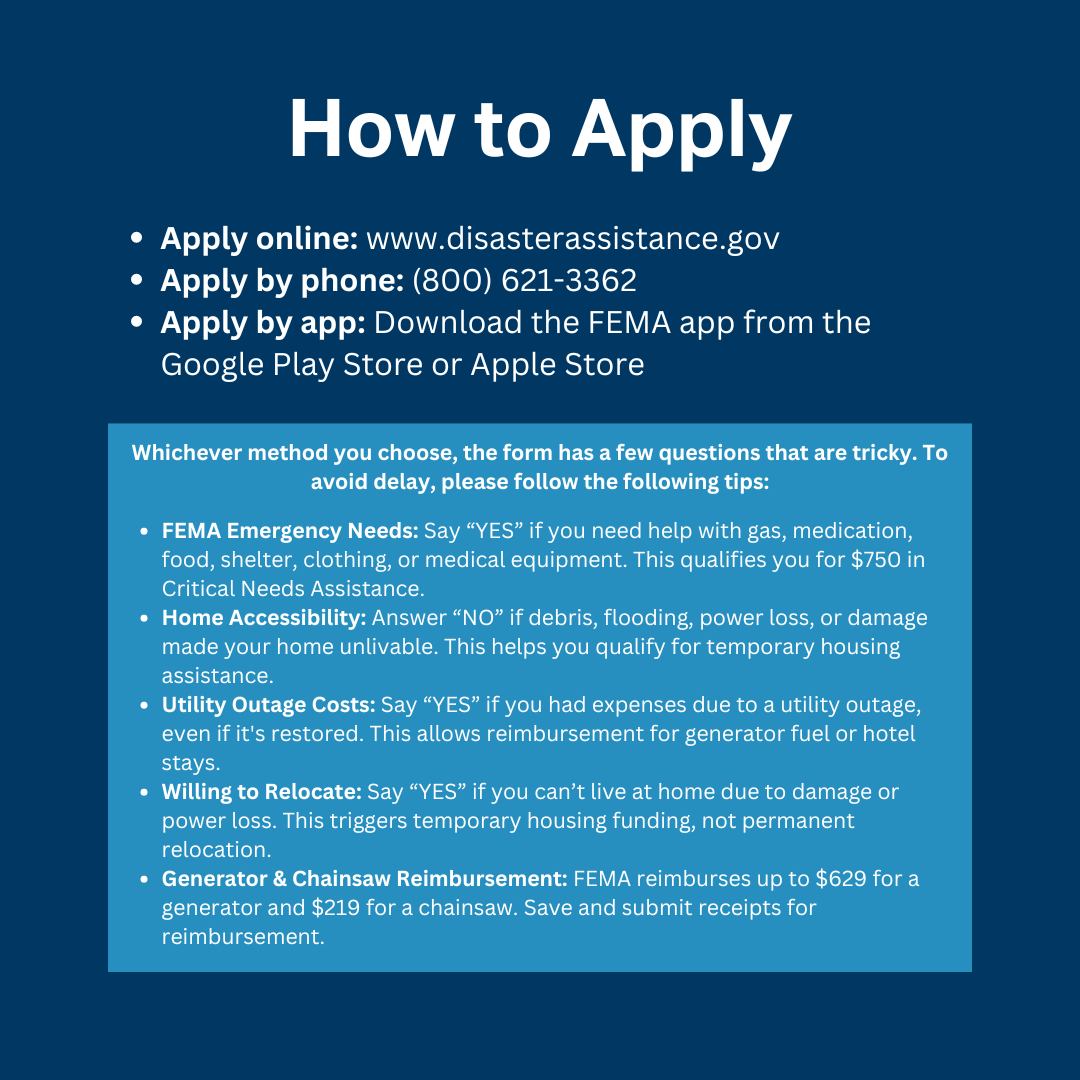
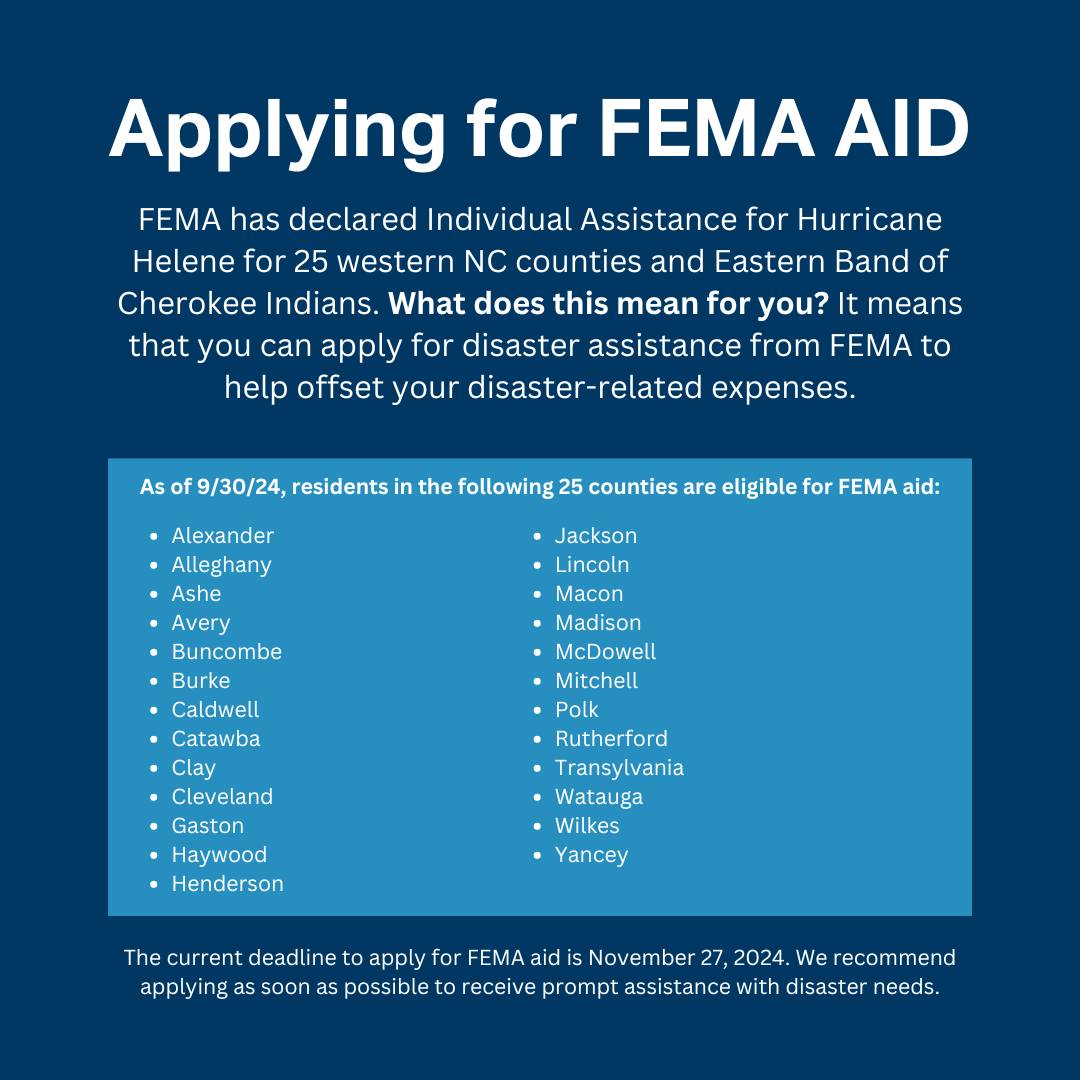
When applying for FEMA aid, knowing how to answer questions can help you access support. From emergency needs to utility reimbursements, here’s what you need to know to get assistance. Learn more at legalaidnc.org/helene
|
|
|
|
|
|
|
NEW! WNC Recovery Resource Database Now Available
This week, the team at NC Housing Coalition participated in multiple statewide and regional calls and began collecting and vetting the growing amount of information around resources and assistance for those impacted by Hurricane Helene in Western North Carolina. There are so many groups that are working tirelessly to coordinate donations, ensure official communications from the state level emergency management team is dispersed effectively, and more importantly, find ways to bring relief to the communities in Western NC that have been overwhelmed by the impacts of Hurricane Helene. See the database here.
|
|
|
NEW! Rescue Teams Continue to Locate Survivors as Communications Improve and More Military Assets Join Storm Response Efforts 2,700 NC National Guard and Military Personnel Serving in the Region
Air search and rescue teams flew 48 additional missions on Saturday, locating 39 survivors stranded in Western North Carolina after Hurricane Helene brought catastrophic flooding to the region. So far 6,586 people and counting have been rescued, evacuated or assisted by search and rescue teams since the storm hit. Almost 50 search and rescue teams have deployed more than 1,600 responders to the region over the past 10 days. Local and state emergency responders now have the assistance of approximately 1,700 North Carolina National Guard and 1,000 active-duty military personnel.
“Continuing search and rescue missions in rough terrain, better communications and more resources on the ground are helping as we race to find missing people, reunite families and coordinate the delivery of supplies,” said Governor Roy Cooper. “The people of Western North Carolina are strong, and they deserve every bit of help we can get them. I’m so grateful for everyone stepping up to help as we dig out from this unprecedented storm.” At Gov. Cooper’s request, nearly 1,000 soldiers from Fort Liberty and Fort Campbell have been mobilized to assist with search and rescue and coordination of air traffic to ensure the safety of relief missions. They are partnering with the North Carolina Department of Transportation to help speed the
clearing of roads, and with county emergency managers to distribute commodities including food and water. An additional 500 active-duty soldiers will join those already deployed. Communications in the region are improving rapidly, making it easier to identify help needed by communities and people. Cellphone providers reported significant gains in service coverage Sunday, with an estimated 80% of access to cell service in the region restored. Federal Emergency Management Agency teams will install a fiber optic cable to support telecom partners in restoring communications to the remaining inaccessible areas. An additional 30 Starlink satellite systems have arrived and will support search and rescue efforts underway at the North Carolina Emergency Response Center and at mobile locations. People and crews in hard hit areas are urged to be careful when removing debris, to ensure they do not disrupt fiber optic cables or cell tower infrastructure critical to keeping
communications open. People in the area should restart their cell phones periodically to allow the devices to reconnect to repaired infrastructure. Read the entire press release here.
|
|
|
NEW! Resources from NCDHHS State Health Director
Please find updates on some of the activities and resources related to Helene response. I will continue to push out updates as we work together on this response
Resources and flexibilities
Community practices
Coordination of efforts of state and professional associations begun
NC Medical Board taking lead on standing up webpage to list community practices that are open in affected counties, analogous to pharmacy webpage
NC Medical Society taking lead on coordination of assessing needs of community practices and to start prioritizing and addressing them
Food access
- We are connecting with grocery stores to understand which ones are operating and which ones are able to accept EBT cards for purchases.
- Out of the 1,668 retailers that accept EBT cards in the impacted western area, at least 1,195 are able to run EBT transactions as of Oct. 3. This number is increasing every day.
- It is likely that people will be able to visit one of the large grocery retail store chains in their area and be able to use their EBT card.
- 44 of the 59 Ingles stores are now able to accept EBT cards.
- Starting Oct. 4, people that have EBT cards can use their cards to purchase hot food from retailers that accept EBT.
- Families who are not able to prepare food at home due to displacement or power outages still have access to warm meals. They can go to gas stations, delis, or grocery stores that participate in the program and buy hot, already prepared food.
- This temporary flexibility (in effect until Nov. 3) applies to all 100 counties in North Carolina and the nearly 700,000 households enrolled in the program. So even if you have evacuated to another area of the state, you can still use your EBT card to get hot food.
Infant Formula
- We have sent 8 pallets (between 120 – 144 cases of formula per pallet) of formula via the National Guard to 34 feeding sites across the impacted counties
- Have shipped formula to multiple counties that have requested it and are currently working to fill orders for hospitals in Rutherford, Jackson, Swain and Haywood by end of day Oct. 4. We have also proactively reached out to counties that were heavily impacted but have not yet made requests.
- Diaper Bank of NC is making daily trips to deliver formula and other infant supplies to the impacted counties.
- We are receiving donations to help with supplies and are developing projections for future needs by county.
Pharmacies
- 223 pharmacies are open in the 25 counites and EBCI Tribal Area with federal disaster declaration.
- Each of the 25 counties, and the EBCI Tribal Area, have at least one pharmacy open and filling prescriptions.
- A list of open pharmacies can be found here - https://link.edgepilot.com/s/c439c269/5QooPCA3WEKm7PnG2EHYrQ?u=https://www.ncbop.org/emergencyoperatingpharmacieshelene.html
- Walmart has opened a Mobile Pharmacy in Boone, and Walgreens is planning mobile pharmacy locations in Hendersonville and Asheville to be opened soon.
- We are also working with local health departments to connect shelters with local pharmacies so people in shelters can get prescriptions. Paired Toe River Health District (Mitchell and Avery Counties) with CVS
Licensed care facilities located in the 25 impacted counties.
- All of the Nursing Homes have been contacted.
- 90% of Adult Care Homes have been contacted. This includes larger assisted living facilities, smaller adult care homes and family care homes.
- All of the Intermediate Care Facilities have been contacted
- All of the Opioid Treatment Providers have been contacted
- 42% of Residential Behavioral Health Providers the serve adults have been contacted
- 72% of licensed group homes and residential facilities for children have been contacted
- We also remain in contact with all 22 acute care hospitals and the VA hospital
Elizabeth Cuervo Tilson, MD, MPH
State Health Director
Chief Medical Officer
NC Department of Health and Human Services
|
|
|
|
|
|
|
|
NEW! Two Additional North Carolina Counties Eligible for FEMA Assistance
Homeowners and renters in Mecklenburg and Swain counties who had uninsured damage or losses caused by Hurricane Helene are now eligible to apply for FEMA disaster assistance. FEMA may be able to help with serious needs, displacement, temporary lodging, basic home repair costs, personal property loss or other disaster-caused needs. Previously, Alexander, Alleghany, Ashe, Avery, Buncombe, Burke, Caldwell, Catawba, Clay, Cleveland, Gaston, Haywood, Henderson, Jackson, Lincoln, Macon, Madison, McDowell, Mitchell, Polk, Rutherford, Transylvania, Watauga, Wilkes and Yancey counties and the Eastern Band of Cherokee Indians were authorized for assistance to households. The quickest way to apply is to go online to DisasterAssistance.gov. You can also apply using the FEMA App for mobile devices or calling toll-free 800-621-3362. The telephone line is open every day and help is available in most languages. If you use a relay service, such as Video Relay Service (VRS), captioned telephone or other service, give FEMA your number for that service. To view an accessible video on how to apply visit Three Ways to Apply for FEMA Disaster Assistance -
YouTube. Read the full press release here.
|
|
|
|
|
NEW! From our Friends at NC Health News:
N.C. universities rally to provide mental health support for students after Helene
While Helene tore through Boone, 20-year-old Mya McClarty braved the heavy downpour to get back to her apartment for her cat, Matcha. Floodwaters forced her to watch from higher ground as the muddy water swirled around her first floor apartment. Read the article here.
The Asheville public water system suffered catastrophic damage from the unprecedented flooding and upheaval caused by the remnants of Hurricane Helene.
While people throughout the city and Buncombe County have been hungering for answers about when their taps might start trickling again with drinkable water, there’s been a barrage of questions, too, about where they can get nonpotable, or gray water. Read the article here.
This piece was first published in The Assembly.
For at least a decade, no list of top places to retire seemed complete without Asheville, hailed for its temperate weather, proximity to natural wonders, and vibrant artistic scene. The retirement-aged population in the mountain city boomed. People 65 years and older accounted for 96 percent of the 3,400-person increase in Buncombe County’s population from 2020 to 2022, the Asheville Watchdog reported. Across Western North Carolina, the share of older people is now about five points higher than the statewide average, data compiled by the state demographer’s office show. Read the article here.
|
|
|
|
|
NEW! NASW-NC Resource Page
The National Association of Social Workers North Carolina Chapter has a resource page that features updates from the State, volunteer opportunities, disaster/trauma response training, veteran disaster assistance, and more. Read them all here
|
|
|
NEW! NCCC Resource Page
The North Carolina Council of Churches has a resource page that feature. Read them all here.
|
|
|
|
|
This section provides links to all previous updates related to our Hurricane Helene recovery efforts. Moving forward, only new
items will be highlighted in the newsletter, but you can still access all past updates here and at our Hurricane Helene Resource Hub for reference and ongoing support.
|
|
|
|
|
|
|
|
|
Crisis Intervention Strategies for SUD Professionals
October 15th, 12:00 - 1:00PM
Presented by: Geri Miller, Ph.D.
Description: SUD professionals need to learn and practice a calm and encouraging approach during a crisis. The theoretical approach and specific techniques of crisis counseling assessment and treatment can readily be integrated into the professional’s overall framework. Suggestions on beneficial approaches and techniques are provided.
Objectives:
Understand theories and techniques of crisis counseling assessment and treatment.
Describe specific techniques of crisis counseling assessment and treatment.
Apply approaches and techniques to one’s own SUD work setting.
This training is free to all- Please register here: https://cvent.me/vxgqDL
|
|
|
|
|
|
|
Disaster Recovery Survey
|
Taking this survey will help APNC understand the state of the members of our community, and will allow us to better understand the needs of our communities.
|
|
|
|
|
For those unaffected by the storm, but still looking for ways to help, you can donate to the official North Carolina Disaster Relief Fund here:
|
If you’re looking for ways to give, here are four funds you can support. These funds are getting urgently needed resources to people directly affected and hardest hit by the storm, including communities with less access to philanthropic dollars:
- Appalachian Helene Response Fund: Donate directly to mutual aid efforts or a recovery fund facilitated by Appalachia Funders Network. Recovery fund donations go through Foundation for Appalachian Kentucky; donors can designate support for NC in notes.
- Emergency and Disaster Response Fund: Support relief efforts by frontline nonprofits in 18 WNC counties and the Qualla Boundary, administered by the Community Foundation of Western NC.
- Organizing Resilience: Provide direct relief through mutual aid and community groups, support economic recovery and small businesses, and promote systemic change to prevent future disasters.
- NC Counts: Donate to grassroots organizations doing recovery work in vulnerable communities. NC Counts Coalition is a nonpartisan, nonprofit 501(c)(3) organization committed to building a healthy, just, and equitable North Carolina through cross-sector partnerships that advance systemic solutions for communities facing systemic barriers, including BIPOC communities, LGBTQ+, low wealth, immigrant, and other communities
|
|
NC Disaster Relief Fund
|
|
|
|
|
|
APNC has created a Hurricane Helene Resource Hub on our website. This hub serves as a centralized location where you can find all of our messages, updates, and important
resources related to disaster recovery efforts. We will be archiving our daily communications and adding key links to help support individuals and communities impacted by the storm.
You can visit the Resource Hub here:
|
|
Hurricane Helene Resource Hub
|
|
|
|
|
|
|
|